





Geo-Fenced Attendance Tracking for Remote and Field Teams
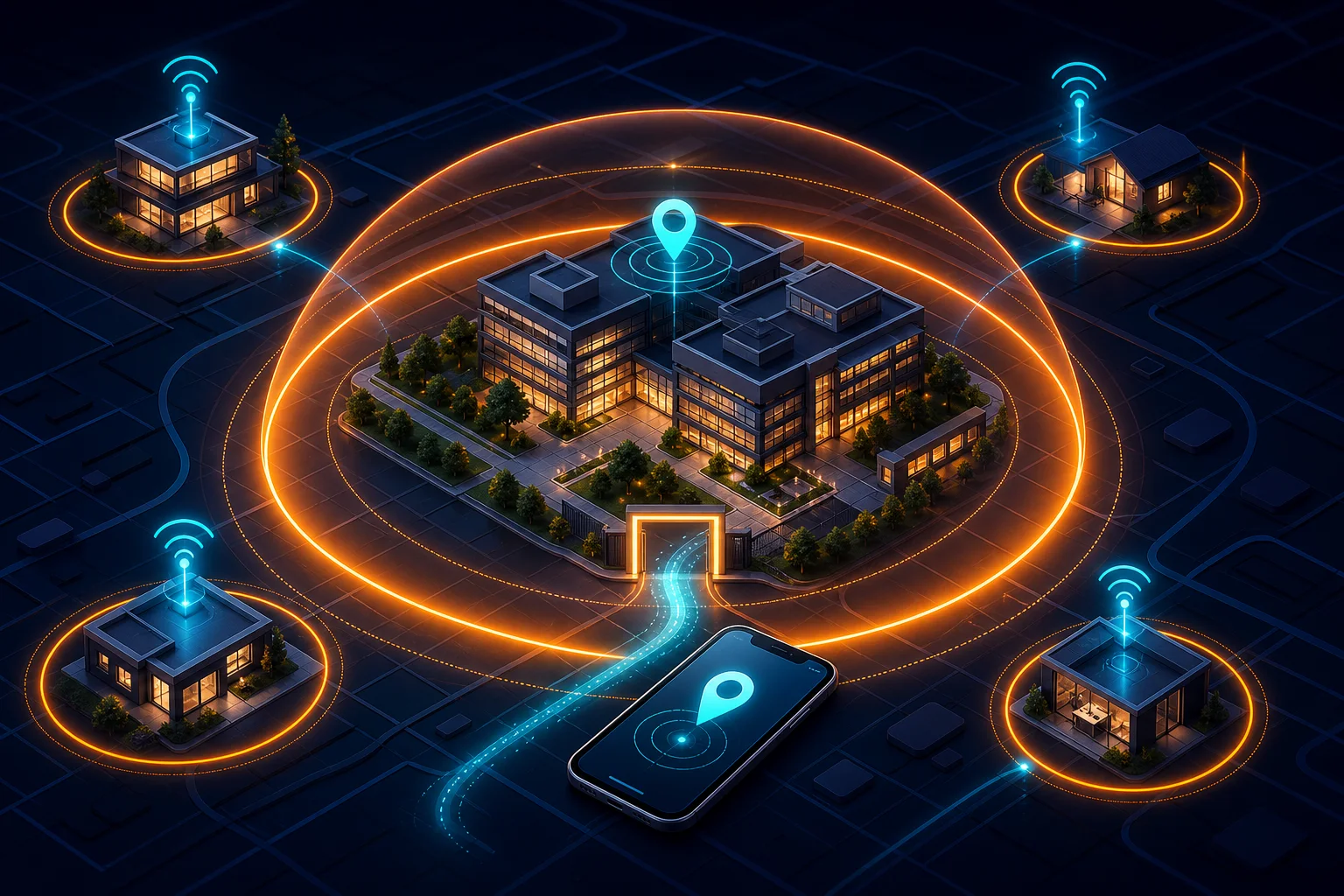
How geo-fenced attendance tracking works, why biometric devices alone can't cover field and remote staff, and how to roll it out without feeling like surveillance.
Biometric fingerprint scanners solve attendance for staff sitting in an office, but they're useless for a sales rep visiting client sites, a technician on a service call, or a delivery rider covering a city zone. Geo-fenced attendance tracking closes that gap — but it has to be implemented thoughtfully or it becomes a source of employee mistrust instead of operational clarity.
How geo-fencing actually works
A geo-fence is a virtual boundary drawn around an approved location — a client site, a branch, or a delivery zone. When an employee opens the attendance app to check in, the system verifies their GPS coordinates fall within that boundary before recording the punch. This prevents check-ins from home while marking the timesheet as on-site, without requiring any physical hardware at the field location.
Designing fences around how the team actually works
The most common rollout mistake is drawing a single tight fence around one location for a role that legitimately visits multiple sites in a day. For field sales and service teams, we configure multiple approved zones per employee, or a "trip mode" that logs a path between locations rather than forcing a single fixed boundary.
Avoiding the "surveillance" perception
Location tracking earns employee trust when its scope is transparent and limited: tracking should activate only at check-in and check-out, not run continuously in the background, and the policy on how location data is used should be communicated clearly during rollout. Systems that are upfront about this see far higher voluntary adoption than ones rolled out silently.
Connecting field attendance to overtime and expense claims
Field attendance data is most valuable when it feeds directly into overtime calculations and travel expense claims — a rep who spent an extra two hours at a client site due to traffic shouldn't need to file a separate paper form to get that time recognised in payroll.
Frequently asked questions
How accurate is GPS geo-fencing for attendance tracking?
Modern smartphone GPS is typically accurate to within 5-10 metres in open areas, which is precise enough for a reasonably sized geo-fence around a client site or branch. Accuracy degrades indoors or in dense urban areas, which is why fences are usually configured with a sensible radius rather than a pinpoint boundary.
Can employees fake their location to check in remotely?
GPS spoofing is technically possible on some devices, which is why production systems combine location data with other signals — device fingerprinting, photo verification at check-in, or requiring the check-in to happen through a specific authenticated app rather than a browser.
The WebSool take
NOA-HRMS's Attendance module includes GPS geo-fencing built for exactly this — multi-zone field teams, trip-based tracking, and a direct feed into overtime and payroll. Talk to us if your current attendance system only works for people sitting at a desk.