




Software Development
Laravel, React, Angular, Spring Boot, Go — plus legacy modernisation, microservices architecture, real-time messaging, and corporate portal development. One senior team, any stack.
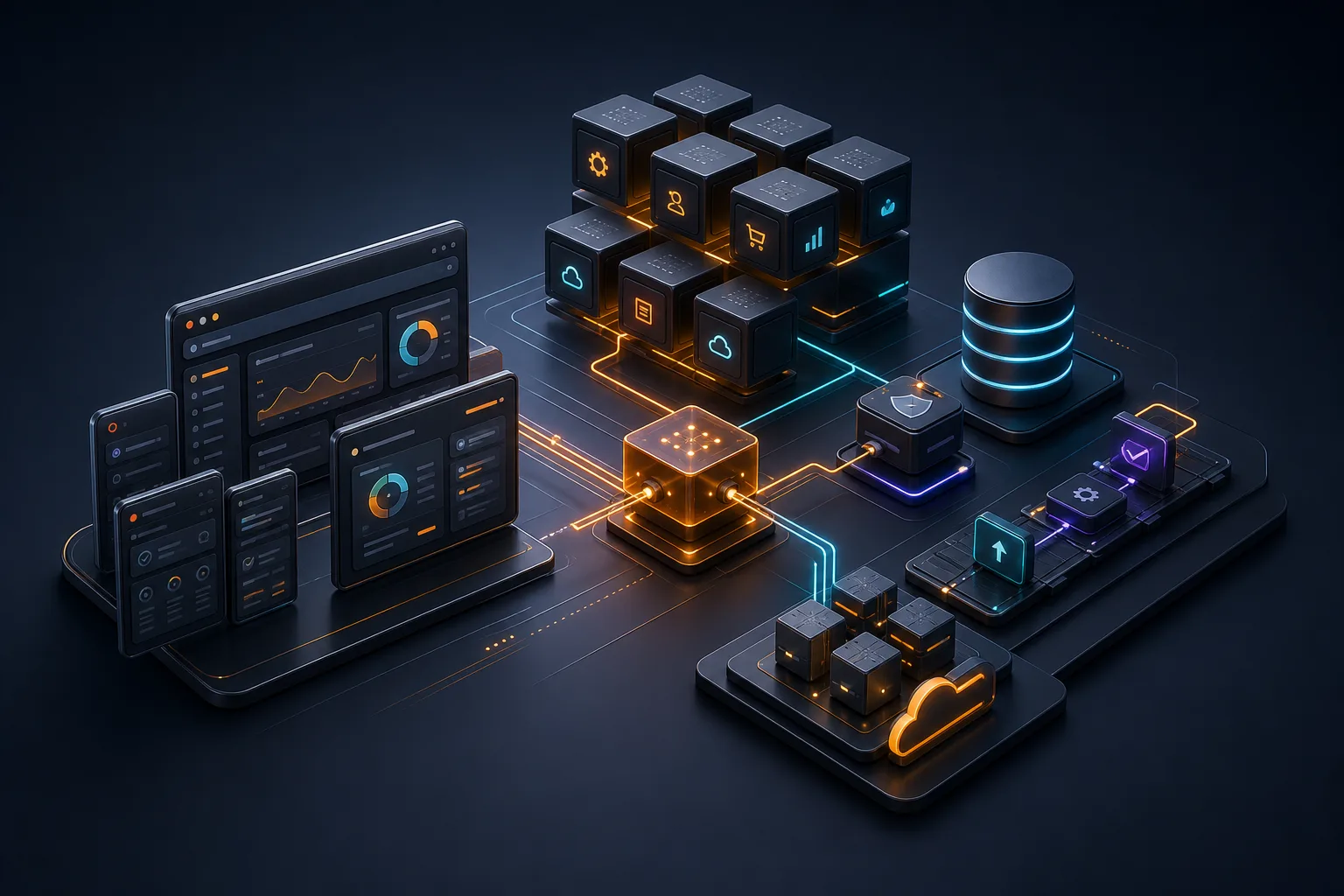
Composable software platform
Web · services · data · delivery
Full stack
Web, API & data ownership
Event driven
Queues, streams & sockets
Cloud native
Containers & CI/CD
The right technology for your problem
Laravel (PHP)
Full-stack web framework for rapid application delivery. SaaS platforms, REST APIs, admin systems, and real-time applications with Livewire and Echo.
React & Next.js
Modern frontend and full-stack JavaScript. Server-side rendering, React Server Components, TypeScript-first, and 90+ Lighthouse scores by default.
Angular Enterprise
Enterprise-grade TypeScript framework for large portals and dashboards. NgRx, Module Federation, Material CDK, and strict architecture rules that scale to 100+ developers.
Spring Boot (Java)
Battle-tested Java framework for enterprise systems. Transaction management, Spring Security, JPA/Hibernate, Kafka/RabbitMQ integration, and cloud-native deployment.
Go (Golang)
Compiled, statically typed language for high-performance APIs and microservices. Goroutine concurrency, gRPC, sub-millisecond latency, and tiny Docker images.
Microservices & Event-Driven
Architecture pattern, not a framework. Domain-driven service decomposition, API gateway, service mesh, message queues, and distributed tracing.
Laravel — done at enterprise scale
Laravel's elegance is easy to abuse. Our team applies SOLID principles, domain-driven design, and layered architecture from day one — producing codebases that scale from 10 users to 10 million without rewrites. We build full-stack apps with Livewire for reactive UIs without the JavaScript build-chain, or Inertia.js for React/Vue frontends backed by a Laravel API.
For background processing, we implement Laravel Queues with Horizon supervision, Redis-backed caching, scheduled commands, and real-time events via Laravel Echo with Pusher or Soketi. Multi-tenant SaaS, filament-powered admin panels, and event-sourced architectures are all in our standard playbook.
When we choose Laravel
- →SaaS products with multi-tenant architecture
- →REST or GraphQL APIs serving mobile/frontend apps
- →Admin panels & CRM/ERP systems (FilamentPHP)
- →Real-time apps (chat, notifications, live dashboards)
- →E-commerce with custom checkout & payment logic
- →Startups needing fast iteration with clean codebase
Rendering strategy guide
SSR (Server-Side Rendering)
Dynamic pages, personalised content, always-fresh data
SSG (Static Site Generation)
Marketing pages, blogs, docs — pre-built for maximum speed
ISR (Incremental Static)
Large catalogues — regenerate pages on demand, cached at edge
RSC (React Server Components)
Interactive islands in server-rendered HTML — zero JS shipped
SPA (Vite + React)
Internal tools, dashboards, apps where SEO is irrelevant
Frontends that perform and scale
We build React and Next.js applications that achieve 90+ Lighthouse scores on mobile as a baseline requirement — not a stretch goal. TypeScript strict mode throughout, minimal client JavaScript with React Server Components, and component APIs designed for handover to your in-house team.
Next.js App Router gives us granular control over rendering strategy per route: static pages at the edge for marketing content, server-rendered pages for personalised dashboards, and streaming responses for AI-powered features. We pair Next.js frontends with Laravel, Spring Boot, or Go backends using tRPC, REST, or GraphQL.
Angular — built for enterprise complexity
Angular's opinionated architecture, dependency injection, and built-in tooling make it the framework of choice for large enterprise portals — HR systems, banking dashboards, ERP front-ends, and government platforms where consistency across dozens of developers matters more than flexibility. We follow Angular's recommended architecture strictly: standalone components, signals for fine-grained reactivity, and NgRx for complex state management.
For organisations with multiple portal applications, we implement Module Federation so each team owns and deploys their feature module independently — sharing a host shell without coordinating releases. Role-based route guards, lazy-loaded feature modules, and Angular's CDK accessibility primitives are included by default.
Enterprise portal use cases
HR & Payroll Portal
Employee self-service, leave management, payroll history, performance reviews, org chart.
Banking Dashboard
Multi-account overview, transaction history, loan management, investment portfolio.
ERP Front-end
Purchase orders, inventory, GL/AP/AR modules, reporting dashboards, approval workflows.
Government Portal
Citizen services, document submission, application tracking, department-specific modules.
Multi-Tenant SaaS Dashboard
Tenant admin, usage analytics, subscription management, white-label branding.
Spring Boot
Spring Boot is the standard for Java enterprise — battle-tested transaction management, Spring Security with OAuth2/JWT, and a mature ecosystem for every enterprise integration pattern. We use it for large-scale financial platforms, insurance systems, and integrations with legacy Java infrastructure.
Best for
Financial institutions, insurance platforms, ERP backends, large-scale enterprise integrations with existing Java infrastructure, and regulated industries requiring mature transaction management.
Go (Golang)
Go compiles to a single binary, handles thousands of concurrent connections with goroutines, and produces Docker images under 10MB. It's our choice for high-throughput API gateways, real-time data pipelines, microservices that need single-digit millisecond latency, and CLI tools. Go code is simple to read, simple to test, and simple to deploy.
Best for
API gateways, high-frequency trading systems, real-time data streaming, fintech backends requiring sub-10ms response times, and microservices needing predictable low memory usage at scale.
Upgrade existing software without the risk
What we upgrade
CodeIgniter / CakePHP / Yii → Laravel 11
Old PHP MVC frameworks with years of technical debt. We migrate module by module, adding type safety, tests, and modern architecture.
PHP 5/7 → PHP 8.3
Version upgrades with deprecation fixes, strict types, named arguments, and match expressions — without breaking production.
jQuery / Backbone → React / Next.js
Replacing server-rendered or jQuery-heavy frontends with React — component by component using an island architecture.
JSP / Struts → Spring Boot + React
Migrating legacy Java web applications to modern REST APIs with a React frontend.
Monolith → Microservices
Decomposing a tightly coupled codebase into independently deployable services using DDD bounded contexts.
On-premise → Cloud-native
Lifting and shifting legacy applications to AWS/GCP, then re-platforming with containers, managed services, and infrastructure as code.
Our migration methodology
Code & Dependency Audit
We assess the current codebase: cyclomatic complexity, security vulnerabilities, outdated dependencies, missing tests, and coupling between modules. The audit produces a prioritised risk map.
Test Baseline
Before changing anything, we write characterisation tests that document what the current system does — even if that includes bugs. These tests are our safety net during migration.
Incremental Migration
We never do a big-bang rewrite. We migrate feature by feature — running old and new code in parallel, routing traffic progressively, and validating at each step.
Zero-Downtime Cutover
Database schema migrations use expand-contract patterns. Traffic cutover uses feature flags or blue-green deployment — so you can roll back in seconds if anything is unexpected.
Knowledge Transfer
We document architecture decisions, create developer onboarding guides, and run knowledge transfer sessions with your team — so the migration doesn't create new bus-factor risk.
Monolithic to microservices — the right way
Domain-Driven Design (DDD)
We identify bounded contexts in your domain — the natural service boundaries that let teams work independently without tight coupling.
Strangler Fig Pattern
New functionality is built as microservices from day one. Existing monolith features are migrated behind an API gateway one bounded context at a time.
Event-Driven Architecture
Services communicate via domain events (Kafka or RabbitMQ) rather than synchronous HTTP — decoupling services and enabling eventual consistency patterns.
API Gateway
A single ingress point routes requests to the correct service, handles authentication, rate limiting, and request transformation — hiding internal service topology from clients.
Service Mesh (Istio)
For large deployments, we implement Istio for mutual TLS between services, traffic management, circuit breaking, and distributed tracing without application code changes.
Data Isolation
Each service owns its data store. We use the Saga pattern for distributed transactions and CQRS + event sourcing for services that need audit trails.
Migration phases
- 1 Monolith audit & DDD event storming workshop
- 2 API gateway + service skeleton setup
- 3 Extract first service (lowest risk, highest value)
- 4 Database decomposition per service
- 5 Event bus integration (Kafka/RabbitMQ)
- 6 Observability: distributed tracing & logging
- 7 CI/CD per service (independent pipelines)
- 8 Progressive traffic migration & validation
Tools we use
RabbitMQ, Kafka, WebSocket & TCP
RabbitMQ
AMQP-based message broker for reliable task queuing, work distribution, and service-to-service communication with guaranteed delivery.
- ·Direct, topic & fanout exchanges
- ·Dead-letter queue (DLQ) handling
- ·Consumer groups & competing consumers
- ·Message TTL & priority queues
- ·Publisher confirms & consumer acks
- ·Laravel Queue driver integration
- ·Spring AMQP (Java)
- ·Delayed message scheduling
Best for
Task queues, order processing, email/SMS dispatch, microservice command routing where delivery guarantee matters.
Apache Kafka
Distributed event streaming platform for high-throughput data pipelines, event sourcing, and real-time analytics at massive scale.
- ·Topics, partitions & consumer groups
- ·Exactly-once delivery semantics
- ·Kafka Streams (stateful processing)
- ·Schema Registry (Avro / Protobuf)
- ·Kafka Connect (DB, S3 sink/source)
- ·Event sourcing & audit log
- ·KSQL real-time analytics
- ·Confluent Cloud or self-hosted
Best for
Event sourcing, fraud detection pipelines, real-time analytics, microservice event buses, and log aggregation at millions of events/sec.
WebSocket
Persistent bidirectional TCP connection for real-time features — notifications, live dashboards, collaborative editing, and instant messaging.
- ·Laravel Echo + Pusher / Soketi
- ·Socket.io (Node.js)
- ·Go WebSocket (gorilla/websocket)
- ·Spring WebSocket + STOMP
- ·Real-time payment status updates
- ·Live dashboard data streaming
- ·Collaborative document editing
- ·Multi-player / live event feeds
- ·Authentication & channel auth
- ·Reconnect & heartbeat handling
Best for
Chat apps, live notifications, real-time dashboards, payment confirmations, collaborative tools, and live auction/trading systems.
TCP / gRPC
Low-level TCP for custom protocols and gRPC for efficient service-to-service communication with Protocol Buffers — faster and smaller than JSON REST.
- ·Protocol Buffer (protobuf) schemas
- ·Unary, server & bidirectional streaming
- ·Go gRPC implementation
- ·Java gRPC (Spring Boot)
- ·gRPC-gateway (REST transcoding)
- ·TLS mutual auth between services
- ·Load balancing & health checks
- ·Client libraries (Go, Java, Python, Node)
- ·gRPC reflection for debugging
- ·Deadline propagation & cancellation
Best for
Internal microservice communication, fintech backends, IoT device protocols, and any service-to-service RPC where JSON overhead matters.
Enterprise portals built for real organisations
HR & Payroll Portal
Employee self-service, leave & attendance, payroll processing, performance reviews, org chart, onboarding workflows, training records, and compliance reporting.
Financial Dashboard
P&L, cash flow, budget vs actual, GL/AP/AR module integration, multi-currency, multi-entity consolidation, and export to Excel/PDF.
Operations & ERP
Purchase orders, inventory management, supplier portal, warehouse pick-list, production scheduling, and quality control workflows.
CRM & Sales Portal
Lead pipeline, contact management, activity timeline, quote builder, contract management, and commission tracking.
Document Management
Version-controlled document repository, approval workflows, e-signature integration, access controls, and compliance retention policies.
Learning Management System
Course builder, video hosting, quiz engine, progress tracking, certification issuance, and SCORM/xAPI compliance.
Role-Based Access Control
Granular permissions per module — read, write, approve, admin — with department and branch scoping. Audit every permission change.
Single Sign-On (SSO)
SAML 2.0, OAuth2, and OIDC integration with your existing identity provider — Azure AD, Okta, Google Workspace, or LDAP.
Immutable Audit Trail
Every data change logged with user, timestamp, before/after values — stored in an append-only log that compliance teams can export.
Domain expertise across every vertical
Fintech & Banking
Payment systems, credit scoring, fraud detection, core banking integrations, lending platforms, and regulatory reporting.
Healthcare
Patient portals, clinical decision support, EMR integrations (HL7/FHIR), telemedicine platforms, and HIPAA-compliant architectures.
Education & EdTech
LMS platforms, student information systems, online exam engines, adaptive learning, and university ERP portals.
Retail & E-Commerce
Custom storefronts, inventory management, POS integration, loyalty systems, and omnichannel fulfilment platforms.
Logistics & Supply Chain
Fleet management, route optimisation, warehouse management systems, carrier API integrations, and real-time tracking.
Manufacturing
MES integration, production scheduling, quality control systems, IoT data collection, and OEE dashboards.
Real Estate
Property portals, automated valuation, CRM for agents, tenant management, and payment & lease management.
Government & Public Sector
Citizen service portals, e-governance platforms, compliance reporting, document management, and GDPR/data sovereignty.
Engineering standards across every project
Security by default
OWASP Top 10, parameterised queries, CSRF protection, CSP headers, and dependency scanning in CI.
API documentation
OpenAPI 3.1 spec, Swagger UI, and Postman collections — written contract-first, before the first line of code.
Test coverage
Unit, integration, and E2E tests. We don't ship features without a test baseline that CI can run on every push.
CI/CD pipeline
GitHub Actions or GitLab CI with automated lint, test, build, and deployment — blue-green or canary to production.
Observability
Structured logging (JSON), distributed tracing (OpenTelemetry), and metrics dashboards (Prometheus + Grafana).
Authentication
JWT, OAuth2, Sanctum, Passport, or Spring Security — with multi-factor auth and refresh token rotation.
Cloud-agnostic
AWS, GCP, Azure, or bare metal. Infrastructure as Code with Terraform. No cloud lock-in.
Database design
Normalised schema design, query optimisation, migration strategy, and read-replica configuration.
RBAC & multi-tenancy
Role-based access control, department/branch scoping, and multi-tenant data isolation strategies.
Performance baseline
100ms p99 API response target. Redis caching, N+1 query elimination, and load testing before launch.
Developer handover
Architecture decision records (ADRs), local dev setup in one command, and team knowledge transfer sessions.
Code review standards
PR review checklist, static analysis (PHPStan/ESLint/SonarQube), and style enforcement in CI.
Why the framework choice matters less than you think
Laravel, Spring Boot, Go, and Angular are all capable of building the same system. The real differentiator is architecture: how the code is structured, how domains are separated, how changes are tested, and how the system evolves over years. A well-architected Laravel application will outlast a poorly designed Spring Boot application, and vice versa. We focus on the architecture first — the framework is a delivery mechanism.
That said, framework choice still matters for team fit, hiring, and ecosystem maturity. We help you make that decision with a short technical discovery session — mapping your requirements, your team's existing expertise, and your long-term maintenance plan to the framework best positioned to serve all three.
When to choose microservices
Microservices solve team scaling problems, not technology problems. If you have a small team and a moderate traffic load, a well-structured monolith is simpler to build, test, deploy, and debug than a distributed system. We're honest about this: we actively discourage microservices for teams under ~15 engineers unless there's a clear domain reason (different scaling requirements per service, different technology requirements, or regulatory isolation).
When microservices are the right answer — large teams, independent release cadences, dramatically different scaling profiles — we have the full infrastructure toolkit: API gateways, service meshes, distributed tracing, and the event-driven patterns that make services genuinely decoupled rather than a distributed monolith in disguise.
Frequently asked questions
Related services
API Development
Well-documented, versioned APIs with rate limiting, auth, and OpenAPI specs.
- REST
- GraphQL
- OpenAPI
- gRPC
Penetration Testing & QA
OWASP pen testing, E2E automation, and load testing for your application.
- OWASP
- Cypress
- Playwright
- k6
Cloud & DevOps
CI/CD pipelines, Docker, Kubernetes, Nginx, AWS & Azure — full deployment infrastructure for your application.
- AWS
- Azure
- Docker
- CI/CD
- Nginx