




Building Production-Grade RAG Systems: Architecture and Best Practices

What separates a RAG demo from a production system that enterprise teams can trust — chunking strategy, retrieval quality, citations and evaluation.
Retrieval-Augmented Generation demos are easy to build and famously hard to trust in production. A weekend prototype that answers questions from a PDF looks impressive right up until it confidently hallucinates a policy that doesn't exist, or retrieves the wrong document because two files have similar headers. The gap between a RAG demo and a production RAG system is almost entirely in the details most tutorials skip.
Chunking strategy determines retrieval quality
How you split source documents into retrievable chunks has more impact on answer quality than which embedding model you choose. Naive fixed-size chunking regularly splits a table or a policy clause across two chunks, destroying its meaning. We use structure-aware chunking that respects document sections, tables and headings, and overlaps chunks slightly so context isn't lost at the boundary.
Hybrid search beats pure vector similarity
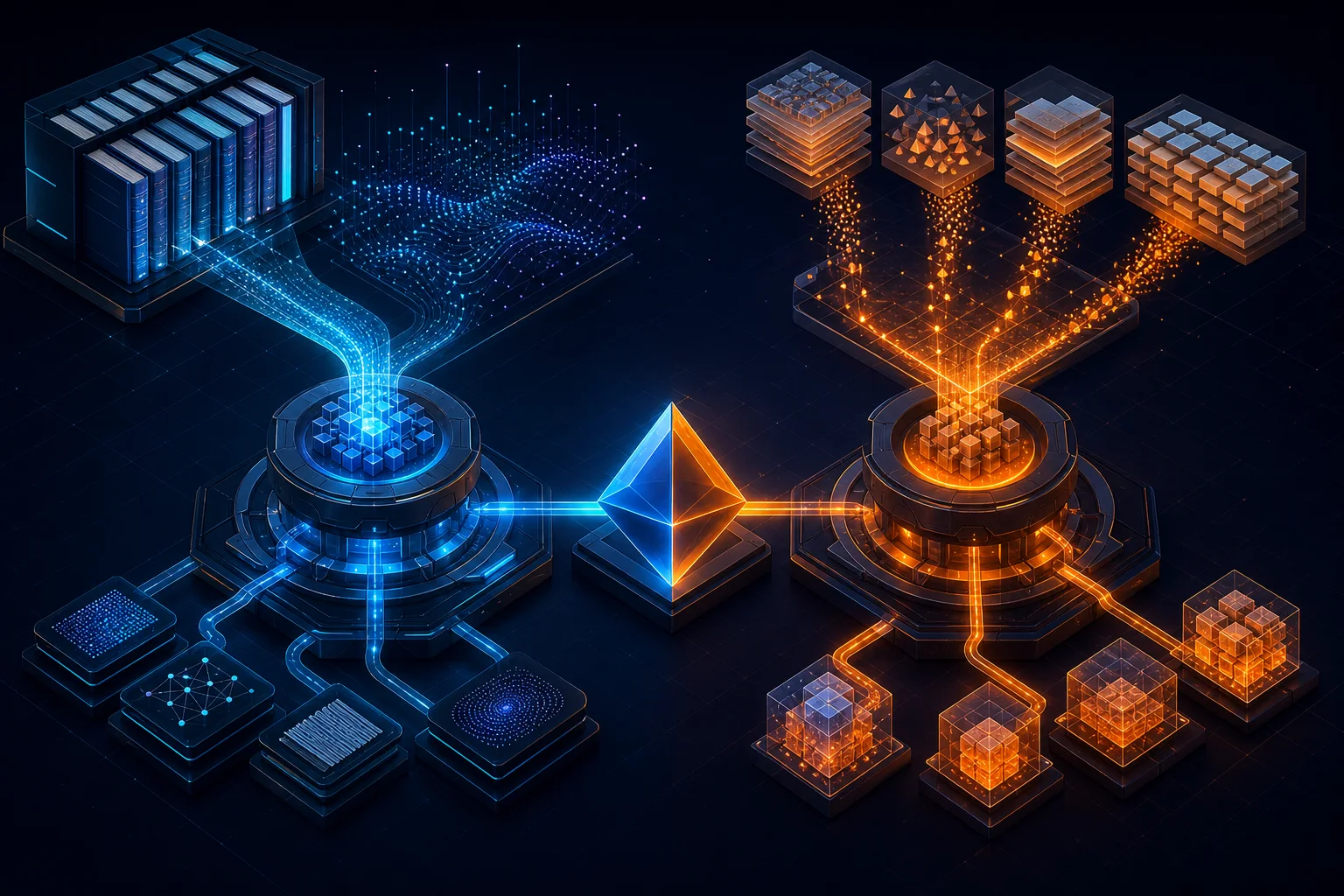
Pure vector similarity search misses exact-match queries — a customer searching for an order number or a specific error code needs keyword search, not semantic similarity. Production RAG systems combine dense vector retrieval with sparse keyword search (BM25 or similar) and re-rank the combined results, which measurably improves retrieval precision over either method alone.
Citations aren't optional for enterprise trust
Every answer a production RAG system gives should be traceable back to its source document and page. This isn't just good UX — it's how enterprise users verify an AI answer before acting on it, and it's the difference between a chatbot that gets adopted and one that gets abandoned after the first wrong answer.
Evaluation has to be continuous, not one-time
Retrieval quality degrades silently as the knowledge base grows and source documents get updated. Production RAG systems need an ongoing evaluation pipeline — a curated set of test questions with known-correct answers, run automatically whenever the knowledge base or retrieval logic changes, so regressions are caught before users notice them.
Frequently asked questions
How is RAG different from just using ChatGPT with a document uploaded?
Uploading a document to a chat interface works for a single conversation but doesn't scale — RAG systems index thousands of documents into a searchable vector database, retrieve only the most relevant chunks for each query, and can serve many concurrent users with consistent, auditable answers.
How do you stop a RAG chatbot from hallucinating?
You can't eliminate hallucination entirely, but you can reduce it significantly with high-quality retrieval, explicit source citations the user can verify, prompting the model to say "I don't know" when retrieval confidence is low, and continuous evaluation against a test set of known-correct answers.
The WebSool take
We build production RAG systems on Claude and OpenAI with hybrid retrieval, source citations and continuous evaluation baked in from day one — not bolted on after the first embarrassing hallucination. If your RAG prototype needs to become something the business can rely on, let's talk architecture.